Crying is one of the most raw, honest, and deeply human things we will ever do.
It is the moment when emotion becomes too large for the body to contain — when grief, joy, relief, or love spills over every carefully constructed wall we have built and demands to be felt completely, openly, and without apology.
And yet, finding the right words to describe that moment with the depth and honesty it deserves is one of the greatest challenges any writer will ever face.
That is exactly where metaphors for crying become not just useful but absolutely essential.
A metaphor doesn’t just describe tears — it recreates the feeling behind them. The tightening throat. The burning eyes. The quiet, unstoppable surrender to something too big and too true to be held back any longer.
When you say tears are “a river that had been dammed for far too long,” that crying is “the heart wringing itself out like a wet cloth,” or that grief “poured out of her like rain from a sky that had been holding it for months,” you are not merely reporting emotion — you are making your reader live inside it.
Whether you are a novelist writing a scene that needs to shatter the reader’s heart in the most honest way possible, a poet searching for an image that captures sorrow with breathtaking precision, or a student crafting an essay that needs genuine emotional depth, these metaphors for crying will give your writing the kind of raw, moving, and unforgettable power that transforms good writing into something truly extraordinary.
What Is a Metaphor? 🌈
A metaphor says that one thing IS another thing — without using “like” or “as.” It paints a strong picture in your mind right away.
For example, instead of saying “She cried a lot,” a metaphor says: “She was a broken faucet.” Suddenly you can picture the tears just pouring out without stopping. That’s powerful writing!
Below you will find 60 fresh, original metaphors for crying — sorted into 10 groups by feeling. Every one comes with a simple meaning, a real example sentence, and an alternative way to say it. Let’s explore!
Simile vs Metaphor — What’s the Difference?
A simile says something is like something else: “She cried like a waterfall.” A metaphor says something is something else: “She was a waterfall.” Metaphors feel stronger and more direct — they make the reader feel the emotion instead of just imagining it!
Category 1Big, Explosive Crying
She was a burst pipe
MeaningCrying so hard and so suddenly that nothing could stop it — like water shooting from a broken pipe.
ExampleThe moment she got the bad news, she was a burst pipe — tears everywhere.
→ Also say: a flood of tearsHis grief was a tidal wave
MeaningA massive, unstoppable force of sadness that knocks you completely off your feet.
ExampleWhen he heard about his dog, his grief was a tidal wave that swept him away.
→ Also say: overwhelming sadnessHer tears were a dam breaking open
MeaningTears held back for a very long time that finally crash through all at once.
ExampleShe had been brave for days, but then her tears were a dam breaking open.
→ Also say: emotions exploding outHe was a volcano of sobs
MeaningA huge eruption of crying that had been building quietly for a long time inside.
ExampleHe had held it in all week — then he was a volcano of sobs in the hallway.
→ Also say: bottled up and explodingHer crying was a thunderclap
MeaningA sudden, shocking burst of loud crying that fills the whole room in an instant.
ExampleHer crying was a thunderclap — it startled everyone in the library.
→ Also say: sudden loud sobsHis sobs were a crashing waterfall
MeaningHeavy, non-stop tears that pour out with great force and keep going and going.
ExampleHis sobs were a crashing waterfall — loud, constant, and impossible to miss.
→ Also say: pouring without stoppingCategory 2Quiet, Gentle Crying
Her tears were morning dew
MeaningTiny, quiet drops of sadness that appear so gently they are barely noticed.
ExampleShe didn’t sob — her tears were morning dew, soft and silent on her cheeks.
→ Also say: small gentle dropsHe was a melting candle
MeaningCrying slowly and quietly, dripping one soft tear at a time without making any noise.
ExampleHe sat by the window, a melting candle — no sound, just slow, warm tears.
→ Also say: slow quiet sadnessHer sadness was a soft drizzle
MeaningLight, steady sadness that falls gently and slowly, like a very soft rain.
ExampleShe wasn’t sobbing — her sadness was a soft drizzle, quiet and steady all morning.
→ Also say: light and gentle tearsHis crying was a whisper in the dark
MeaningSo quiet that you could barely hear it — a deep sadness that stayed almost hidden inside.
ExampleIn bed that night, his crying was a whisper in the dark — barely a sound.
→ Also say: hidden quiet griefHer tears were a leaking tap
MeaningA slow, steady flow of tears that drip out one by one and just keep coming without stopping.
ExampleShe wasn’t crying loudly — her tears were a leaking tap, slow and unstoppable.
→ Also say: slow steady dropsHis sorrow was a sleepy river
MeaningA calm, slow-moving sadness that keeps flowing gently — not violent, but always there.
ExampleHis sorrow was a sleepy river — quiet but deep, flowing through him all day long.
→ Also say: calm and lasting sadnessCategory 3Heartbroken Crying
Her heart was a shattered mirror
MeaningCompletely broken into pieces — a deep, painful sadness that feels impossible to put back together.
ExampleWhen he left, her heart was a shattered mirror, and the tears came with every sharp piece.
→ Also say: broken and in piecesHe was a crumpled letter
MeaningSoft, crushed, and full of pain — like a message that was thrown away, all wrinkled and wet.
ExampleAfter the goodbye, he was a crumpled letter — folded up with sadness, hard to read.
→ Also say: crushed with sadnessHer tears were fallen petals
MeaningBeautiful but sad — tears that fall because something lovely has come to an end.
ExampleAs the goodbye ended, her tears were fallen petals — soft, helpless, and full of love.
→ Also say: bittersweet tearsHis grief was a locked room
MeaningA sadness so deep it felt shut inside him — closed off from the world, full and dark and still.
ExampleHe didn’t talk about it — his grief was a locked room, and the tears were what leaked under the door.
→ Also say: hidden deep painShe was a wilting flower in the rain
MeaningDrooping, soft, and exhausted from sadness — too worn out to stand up straight anymore.
ExampleAfter hearing the news, she was a wilting flower in the rain — bending under the weight of it all.
→ Also say: tired and heartbrokenHis cry was a cracked bell
MeaningA voice full of sadness that rings out but sounds broken — shaky, unsteady, and full of hurt.
ExampleWhen he finally spoke, his cry was a cracked bell — the words trembled and fell apart.
→ Also say: shaky broken voiceCategory 4Happy Tears
Her tears were liquid sunshine
MeaningBright, warm, joyful tears — crying not from sadness but from a heart too full of happiness.
ExampleWhen she won the award, her tears were liquid sunshine — warm and golden on her cheeks.
→ Also say: tears of pure joyHe was an overflowing cup of joy
MeaningSo full of happy feelings that they spill out as tears — there is simply no room left to hold them in.
ExampleAt the finish line, he was an overflowing cup of joy — tears and laughter all at once.
→ Also say: bursting with happinessHer happy tears were a rainbow after a storm
MeaningBeautiful, colourful tears that come right after something hard is finally over and everything becomes good again.
ExampleHer happy tears were a rainbow after a storm — all that struggle, now turning into something beautiful.
→ Also say: hope and reliefHis eyes were sparkling rivers
MeaningEyes shining bright with happy tears — full of light and movement and joy.
ExampleWhen he saw his family at the gate, his eyes were sparkling rivers of happiness.
→ Also say: eyes shining with joyShe was a garden after the first rain
MeaningRefreshed, grateful, and alive — tears that feel good because something wonderful has just arrived.
ExampleHolding her newborn baby, she was a garden after the first rain — crying from pure, fresh joy.
→ Also say: grateful joyful tearsHis tears were golden coins falling
MeaningEach tear feels precious and special — happy crying that you will always remember.
ExampleAt his daughter’s graduation, his tears were golden coins falling — each one worth a lifetime of love.
→ Also say: precious happy tears“Crying is not weakness — it is the heart speaking in its truest voice.”
— A favourite writing sayingCategory 5Angry or Frustrated Crying
Her tears were hot coals
MeaningBurning, angry tears that sting as they fall — full of fire and fury, not just sadness.
ExampleShe was furious — her tears were hot coals, searing down her cheeks as she shouted.
→ Also say: burning angry tearsHe was a boiling pot with a lid on
MeaningAnger and hurt bubbling up inside, trying to stay controlled — until the lid finally rattles off.
ExampleHe was a boiling pot with a lid on — and then the tears came flying out all at once.
→ Also say: pressure finally releasingHer frustration was a stormy sea
MeaningWild, choppy, restless — tears mixed with anger that toss you around and don’t let you be still.
ExampleHer frustration was a stormy sea — crashing waves of tears and angry words.
→ Also say: angry and emotionalHis angry tears were sparks from a fire
MeaningBright, sharp little bursts of emotion — tears that come flying out of frustration and injustice.
ExampleWhen no one believed him, his angry tears were sparks from a fire — fast and furious.
→ Also say: sharp bursts of emotionShe was a storm cloud ready to burst
MeaningDark, heavy, and full of feelings — one small thing could make the whole storm let loose.
ExampleDon’t say the wrong thing — she was a storm cloud ready to burst at any moment.
→ Also say: about to explodeHis cry was a slammed door
MeaningSudden, sharp, and full of force — crying that comes out hard and fast with all the emotion behind it.
ExampleHis cry was a slammed door — one loud, startling burst that shook everyone in the room.
→ Also say: sharp sudden releaseCategory 6Tired or Worn-Out Crying
She was a wrung-out cloth
MeaningCompletely squeezed dry from crying so much — nothing left inside, limp and exhausted.
ExampleAfter hours of sobbing, she was a wrung-out cloth — empty and too tired to feel anything more.
→ Also say: cried out and emptyHis tears were the last drops from an empty jug
MeaningCrying when there is almost nothing left — the very last little bit of emotion squeezing out.
ExampleHis tears were the last drops from an empty jug — barely anything left, but still coming.
→ Also say: almost cried outShe was a deflated balloon
MeaningAll the air and energy gone out — flat, quiet, and still after letting everything out in tears.
ExampleAfter the long cry, she was a deflated balloon — sagging softly on the sofa.
→ Also say: flat and spentHis sadness was a heavy fog at midnight
MeaningA thick, slow, exhausted sadness that settles over everything late at night when you are too tired to fight it.
ExampleHis sadness was a heavy fog at midnight — blanketing everything quietly as tears slid down.
→ Also say: deep night-time sadnessShe was a fading candle
MeaningA quiet, dying flame — crying softly as the last bit of energy goes out, growing dimmer with each tear.
ExampleShe was a fading candle at the end of the night — crying softly until she fell asleep.
→ Also say: quietly fading awayHis tears were the last embers in a cold fire
MeaningThe very last flickering pieces of emotion — almost gone, but still glowing faintly with sadness.
ExampleHis tears were the last embers in a cold fire — tiny, quiet, almost nothing left.
→ Also say: nearly cried dryCategory 7Lonely Crying
She was an empty house in winter
MeaningCold, hollow, and silent — the kind of lonely that echoes when there is nobody there to comfort you.
ExampleWithout her friends, she was an empty house in winter — cold walls and quiet tears.
→ Also say: hollow and aloneHis crying was a lone wolf howling
MeaningDeep, aching sadness sent out into a world that feels too big and too empty — nobody howling back.
ExampleIn the empty flat, his crying was a lone wolf howling — big sadness, no one to hear it.
→ Also say: crying with no one to answerHer tears were letters sent to no one
MeaningCrying that goes out into the world with no one to receive it — grief that nobody sees or reads.
ExampleHer tears were letters sent to no one — full of everything she wanted to say, but heard by nobody.
→ Also say: unseen lonely griefHe was an untouched chair at the table
MeaningThere but forgotten — the painful loneliness of being present but feeling invisible and uncared for.
ExampleHe was an untouched chair at the table — left out, crying quietly where nobody looked.
→ Also say: left out and invisibleHer sadness was a lighthouse with no ships
MeaningSending out a signal of pain, but no one is close enough to see it or come to help.
ExampleHer sadness was a lighthouse with no ships — flashing her pain into the dark, all alone.
→ Also say: reaching out to nobodyHis tears were an echo in a cave
MeaningCrying that bounces back to you — the sadness returns because there is no one there to catch it.
ExampleHis tears were an echo in a cave — coming back to him again and again with no one to help.
→ Also say: sadness coming back aloneCategory 8Healing and Relief Tears
Her tears were a cleansing rain
MeaningTears that wash away the dirt of sadness — after crying, you feel lighter, fresher, and clean inside.
ExampleShe cried and cried, and when it was done her tears were a cleansing rain — everything felt washed away.
→ Also say: tears that healHis crying was a deep, releasing breath
MeaningThe huge exhale after holding everything in — the moment you finally let go and feel free.
ExampleHis crying was a deep, releasing breath — all that tension finally gone, flooding out in tears.
→ Also say: letting everything goHer tears were melting ice on a warm day
MeaningThe feeling of something hard and cold inside you slowly softening and running free as tears.
ExampleHer tears were melting ice on a warm day — the frozen sadness inside her finally thawing out.
→ Also say: softening and releasingHis grief was a seed becoming a flower
MeaningSadness that slowly turns into something beautiful — tears watering the soil for new growth to come.
ExampleHis grief was a seed becoming a flower — the crying was painful, but something hopeful grew from it.
→ Also say: pain turning to growthShe was a knot slowly untying itself
MeaningRelief coming gradually — all the tightness inside you loosening with each tear that falls.
ExampleShe was a knot slowly untying itself — crying softly until all the tension was gone.
→ Also say: tension slowly easingHis tears were the spring thaw
MeaningAfter a long cold time of holding feelings in, the warmth of crying finally breaks through — like ice melting in spring.
ExampleHis tears were the spring thaw — months of frozen feeling finally flowing free and warm.
→ Also say: emotional thawingCategory 9Surprised or Unexpected Crying
Her tears were an ambush
MeaningCrying that jumps out and catches you completely off guard — you had no idea it was coming.
ExampleShe was laughing one second — and then her tears were an ambush, totally unexpected.
→ Also say: caught off guard cryingHis cry was a trapdoor opening
MeaningSuddenly falling through a hidden floor of emotion — a surprise drop into deep feeling without any warning.
ExampleHis cry was a trapdoor opening — one moment normal, the next in free fall through sadness.
→ Also say: sudden emotional dropHer tears were a power cut
MeaningEverything goes dark all of a sudden — the emotional light switches off and tears take over completely.
ExampleShe was fine all day — then her tears were a power cut, shutting down everything at once.
→ Also say: suddenly overwhelmedHis sadness was a hidden current
MeaningSwimming along fine on the surface — until the pull from underneath drags the tears out without warning.
ExampleHis sadness was a hidden current — he seemed okay until it pulled him under without warning.
→ Also say: pulled under by surpriseHer tears were an uninvited guest
MeaningCrying that shows up even when you didn’t invite it — arriving without knocking, staying longer than expected.
ExampleHer tears were an uninvited guest — appearing at the worst moment, refusing to leave.
→ Also say: unwanted sudden tearsHis cry was a crack of lightning
MeaningBright, sudden, impossible to miss — a bolt of emotion that cracks the calm sky without any warning at all.
ExampleHis cry was a crack of lightning — one sharp, startling flash of emotion in the middle of silence.
→ Also say: sudden flash of feelingCategory 10Brave Crying
Her tears were battle scars
MeaningMarks of strength — crying that shows how hard you fought and how much you went through to get here.
ExampleHer tears were battle scars — proof of every hard thing she had overcome to reach this moment.
→ Also say: marks of a survivorHe was a mountain letting the river through
MeaningStrong and solid, but allowing water to flow — brave enough to cry without losing any of his strength.
ExampleHe was a mountain letting the river through — big and strong, but with tears running freely down.
→ Also say: strong and still cryingHer crying was a flag still flying in the storm
MeaningBattered and wet — but still standing, still waving. Proof that you can cry and still be strong.
ExampleHer crying was a flag still flying in the storm — soaked through, but not coming down.
→ Also say: standing while falling apartHis tears were armour coming off
MeaningThe brave act of removing the hard shell you wear to protect yourself — letting someone see the real, soft inside.
ExampleHis tears were armour coming off — the strongest thing he had ever done was let himself cry.
→ Also say: brave enough to feelShe was a lighthouse in the rain
MeaningCrying but still shining — still guiding others through the dark even while the storm is all around you.
ExampleShe was a lighthouse in the rain — crying as she comforted her children, still their brightest light.
→ Also say: strong for others while hurtingHis tears were the last step of a long climb
MeaningCrying at the very top — after all the hard work and struggle, the emotion finally flows when you finally make it.
ExampleHis tears were the last step of a long climb — joy and exhaustion mixed together at the summit.
→ Also say: tears of triumph📊 Quick Reference — All 10 Types at a Glance
| Type of Crying | Best Metaphor Example | What It Feels Like |
|---|---|---|
| Big & explosive | A burst pipe | Sudden, unstoppable flood |
| Quiet & gentle | Morning dew | Soft, barely-there tears |
| Heartbroken | A shattered mirror | Broken, sharp, painful |
| Happy tears | Liquid sunshine | Warm, bright, joyful |
| Angry tears | Hot coals | Burning, fierce, fiery |
| Tired crying | A wrung-out cloth | Emptied, limp, exhausted |
| Lonely crying | An echo in a cave | Hollow, returning to you |
| Healing tears | A cleansing rain | Washing away the hurt |
| Surprised crying | An ambush | Totally unexpected |
| Brave crying | Armour coming off | Strong enough to feel |
✏️ How to Use Metaphors in Your Writing
Find the right feeling first. Is your character angry, happy, heartbroken, or tired? Choose the matching category.
Pick a metaphor and use it directly: “He was a volcano of sobs” — no “like” or “as” needed. That’s what makes it powerful!
Make it your own! Change the words slightly to fit your story. “She was a burst pipe” could become “Her grief was an open tap.”
Use one at a time. One strong metaphor is far better than three weak ones in a row.
💡 Writing Tips for Using Metaphors Well
- Feel before you write. Close your eyes and picture the emotion. What does it look like? What does it remind you of? That image is your metaphor.
- Match the size to the feeling. A big cry needs a big metaphor (“a tidal wave”). A quiet cry needs a small one (“morning dew”). Don’t mix them up.
- Avoid tired old metaphors. “A river of tears” is used everywhere. Try something fresh — “her tears were an ambush” or “his sadness was a locked room.”
- Invent your own! You can create original metaphors too. Just ask yourself: if this feeling were an object or a place or a thing, what would it be?
🎯 Quick Quiz — Test Yourself!
Can you match the metaphor to its meaning? Choose the best answer for each question!
You Are Now a Metaphor Master!
Crying is one of the most human things we do. It can be loud like a tidal wave or quiet like morning dew. It can be brave like armour coming off, or healing like a cleansing rain.
Metaphors give us the words to say all of this — powerfully and beautifully. Instead of “she cried a lot,” you can say “she was a burst pipe.” Instead of “he was sad,” you can say “his grief was a locked room.”
Try using one of these 60 metaphors the next time you write. Or better still — create your very own. The best writers aren’t the ones who memorise the most phrases. They are the ones who feel deeply and find their own words.
Conclusion:-
Tears are never just water.
They are the overflow of everything we carry — the grief we could not speak, the joy too large for words, the relief of finally putting down a weight we have been carrying alone for far too long.
And they deserve language that honors every single drop.
The best metaphors for crying do exactly that. They take one of the most vulnerable, most honest, and most universally human experiences in existence and give it the kind of vivid, moving, and emotionally precise language that makes every reader stop breathing for just a moment and quietly think — “yes, that is exactly what it feels like.”
Whether your favorite was “tears like a river finally breaking free,” “the heart wringing itself out like a wet cloth,” or “grief pouring out like rain from a sky that had been holding it for months,” every metaphor on this page was chosen to help you express emotion with a depth, honesty, and beauty that plain language simply cannot reach.
Because the moments that move us to tears are never small.
They are the moments that remind us we are alive, that we love deeply, that we feel fully, and that we are brave enough to let it show.
The right metaphors for crying in your writing don’t just describe emotion — they become it, reaching into the reader’s chest with quiet, steady hands and reminding them of every feeling they have ever been too afraid to name out loud.
Bookmark this page. Share it with someone who feels everything deeply. And never again find yourself searching for the words to honor the most honest and beautifully human moments life will ever give you.
Also Read
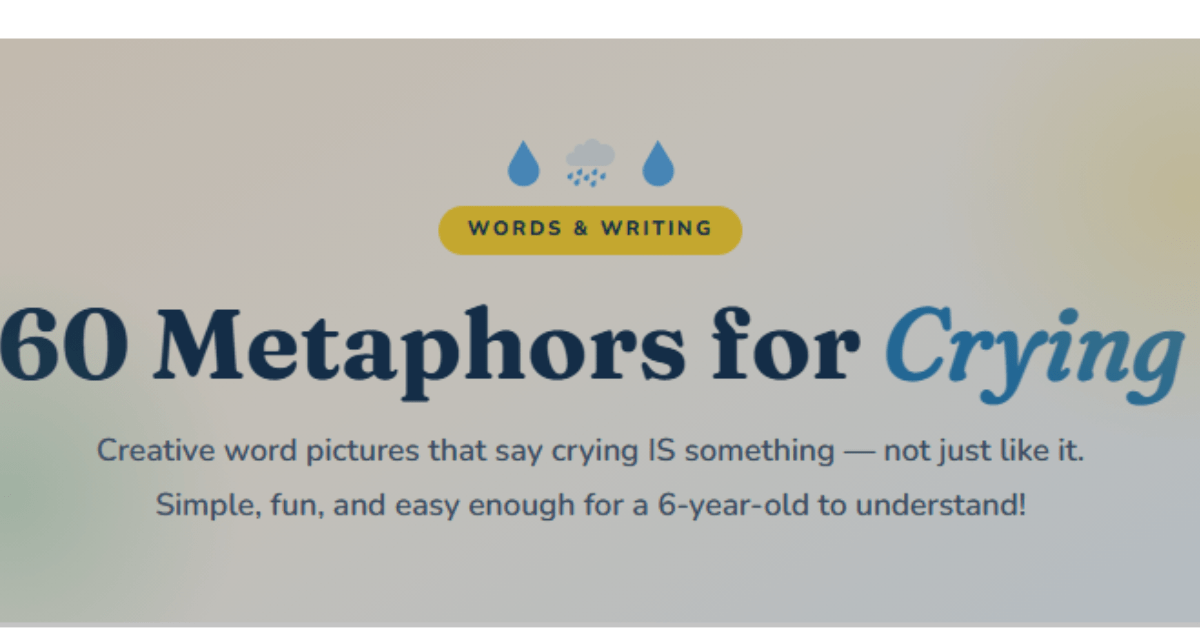
60 Metaphors for Crying — With Meaning, Examples & a Fun Quiz
People also ask
What is a metaphor for tears?
Some of the most powerful and poetically resonant metaphors for tears include:
“Tears are the words the heart cannot speak” — capturing the profound truth that crying often expresses what language simply does not have the courage or capacity to say
“Tears are the soul’s silent confession” — suggesting that what spills from the eyes reveals what the mind has been carefully and quietly concealing for far too long
“Tears are rain from a sky that has been holding its grief since the last storm” — a deeply atmospheric image of emotion building slowly and inevitably until release becomes the only possible outcome
“Tears are the heart’s way of washing itself clean” — honoring crying not as weakness but as a necessary and deeply restorative act of emotional renewal and self-healing
Each metaphor approaches tears from a different angle, giving writers a rich and varied palette of emotional imagery to draw from depending on the tone, context, and depth of feeling they are trying to express.
How to poetically describe crying?
Poetically describing crying is about capturing not just the tears themselves but the entire emotional landscape surrounding them. Some beautifully expressive ways to achieve this include:
“Her eyes became oceans that no longer had the strength to hold their tides” — suggesting the gradual, inevitable overflow of emotion that has been contained for far too long
“He dissolved quietly, like a candle that had finally burned down to its last flickering inch” — capturing the slow, exhausted surrender of someone who has nothing left to hold back
“The tears fell like the first rain after a drought — unexpected, unstoppable, and desperately needed” — honoring crying as a release so necessary that the body itself demands it regardless of time or place
“She came apart at the seams like a letter written in too much pain to be folded neatly ever again” — a deeply literary image that frames emotional breakdown as something achingly honest and human
The key to poetically describing crying is to focus on what the tears reveal rather than simply what they look like — because the most moving descriptions of crying are always really descriptions of the feeling that made them fall.
How do you say “cry” in a fancy way?
The English language offers some wonderfully elegant and expressive alternatives to the plain word “cry,” including:
“Weep” — timeless, graceful, and carrying a quiet dignity that transforms crying into something almost ceremonial in its emotional weight and beauty
“Shed tears” — gentle and understated, suggesting crying with a restrained, dignified sorrow rather than overwhelming and uncontrollable release
“Dissolve into grief” — vivid and deeply literary, capturing the complete emotional surrender of someone who can no longer maintain any pretense of composure
“Lament” — ancient, powerful, and suggesting a crying that is not just personal but almost musical in its expression of loss, longing, and irreversible sorrow
“Keen” — a rarely used but hauntingly beautiful word rooted in Irish tradition, describing a crying so deep and so raw that it becomes almost a song of grief unto itself.
Is crying good for cortisol?
Yes — research suggests that crying can actually help reduce cortisol levels in the body, making it a genuinely powerful and healthy emotional release mechanism rather than simply a sign of distress or weakness. Here is what the science tells us:
Emotional tears contain stress hormones — including cortisol itself, meaning that crying literally expels stress from the body in a way that few other emotional responses can replicate
Crying activates the parasympathetic nervous system — which is responsible for the body’s rest and recovery response, helping to slow the heart rate, lower blood pressure, and restore a sense of calm after overwhelming emotional arousal
The relief after crying is physiological, not just psychological — meaning that the feeling of lightness and emotional release that follows a good cry is not imagined but is a real and measurable biological response happening inside the body
Suppressing tears may increase cortisol — research suggests that holding back crying when the body needs to release can actually maintain or elevate stress hormone levels, making emotional suppression potentially more harmful than the vulnerability of letting tears fall
So the next time you feel the tears coming — let them. Your body already knows exactly what it needs.